

Gynaecological cancer surgery
Interval Cytoreductive Surgery (ICRS) and Heated Chemotherapy (HIPEC)
Helping you understand your treatment.
Being diagnosed with advanced ovarian cancer can be overwhelming, particularly when your treatment involves several different stages. At Gynae Solution, we believe you should have a clear understanding of what is being recommended, why it is being recommended and what you can expect.
For some women with advanced ovarian, fallopian tube or primary peritoneal cancer, treatment may involve chemotherapy followed by major surgery to remove as much visible cancer as possible. This is known as interval cytoreductive surgery (ICRS) or interval debulking surgery.
For carefully selected patients, the operation may be combined with hyperthermic intraperitoneal chemotherapy (HIPEC), heated chemotherapy circulated directly inside the abdomen during surgery.
HIPEC is a specialist treatment and is not suitable for everyone. The decision requires careful assessment of the cancer, response to chemotherapy, the possibility of completely or optimally removing visible disease, your general health and your wishes.
What is interval cytoreductive surgery?
Cytoreductive surgery, sometimes called debulking surgery, aims to remove as much visible ovarian cancer as safely possible.
In some patients with advanced ovarian cancer, it may not be possible or advisable to perform major surgery when the cancer is first diagnosed. Instead, chemotherapy is given first to shrink or control the cancer.
This is known as neoadjuvant chemotherapy.
If the cancer responds appropriately and surgery is considered feasible, an operation is then performed. This is called interval cytoreductive surgery.
Further chemotherapy is usually given after surgery as part of the overall treatment plan.
The aim of cytoreductive surgery is to remove all visible cancer where this can be achieved safely. The amount of cancer remaining after surgery is an important factor in determining subsequent treatment and outcomes.
What is HIPEC?
HIPEC stands for hyperthermic intraperitoneal chemotherapy.
It is a specialised form of chemotherapy delivered directly into the abdomen during an operation.
Once the surgeon has removed as much visible cancer as possible, heated chemotherapy is circulated throughout the abdominal cavity. This allows the chemotherapy to come into direct contact with the surfaces where microscopic cancer cells may remain.
The chemotherapy is then drained from the abdomen before the operation is completed.
Unlike conventional chemotherapy, which is usually delivered into a vein and travels throughout the body, HIPEC is delivered directly into the abdominal cavity and is heated to a controlled temperature. NICE describes the procedure as involving heated chemotherapy generally between approximately 40°C and 48°C, although the exact drug, temperature and duration can vary according to the treatment protocol.
HIPEC is an additional treatment during surgery. It does not automatically replace the chemotherapy you receive through a drip before or after your operation.
Why combine surgery with HIPEC?
Advanced ovarian cancer can spread across the surfaces within the abdomen and pelvis.
Surgery aims to remove visible tumour deposits. HIPEC is intended to treat microscopic cancer cells that may remain after the visible disease has been removed.
The concept is therefore:
Chemotherapy, surgery to remove visible cancer, heated chemotherapy inside the abdomen, then further systemic treatment where appropriate.
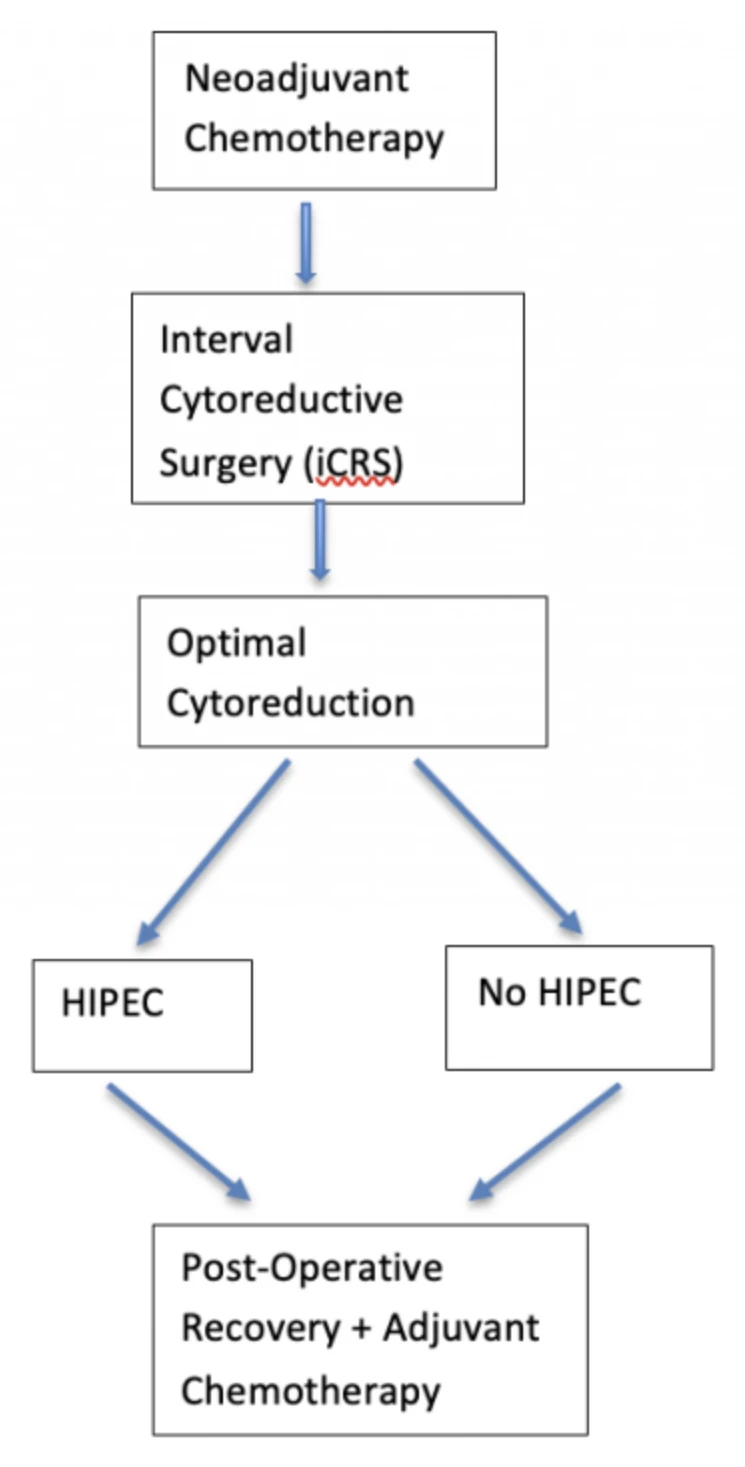
The potential advantage is that chemotherapy is delivered directly to the area at greatest risk of microscopic residual disease.
However, HIPEC is not a replacement for careful cancer surgery or systemic chemotherapy. Its potential benefit depends on selecting the right patients and achieving an appropriate level of tumour removal.
Who may be considered for HIPEC?
HIPEC is not appropriate for every person with ovarian cancer.
The strongest randomised evidence relates to carefully selected patients with stage III epithelial ovarian cancer who:
- have received neoadjuvant chemotherapy
- have not experienced disease progression during chemotherapy
- are fit enough to undergo major surgery
- have adequate organ function, particularly kidney function
- have disease that the specialist surgical team believes can be removed completely or to an appropriate minimal residual level
- are assessed within a specialist multidisciplinary team.
The original OVHIPEC-1 trial studied patients who had received at least three cycles of carboplatin and paclitaxel and were considered suitable for interval cytoreductive surgery.
Your individual circumstances are more important than any single eligibility criterion. The decision will take into account your scans, response to chemotherapy, distribution of the cancer, overall fitness and the complexity of surgery that may be required.
What cancers can HIPEC be used for?
HIPEC may be considered in selected patients with cancers involving the abdominal lining, including certain cases of:
- ovarian cancer
- fallopian tube cancer
- primary peritoneal cancer.
The evidence and treatment recommendations differ according to the type and stage of cancer.
HIPEC should not be presented as a routine treatment for every advanced or recurrent ovarian cancer. In particular, current specialist guidance does not recommend HIPEC as routine treatment for relapsed ovarian cancer.
How is your suitability assessed?
Before considering ICRS and HIPEC, you will usually undergo detailed assessment.
This may include:
- CT or other appropriate imaging
- review of previous scans
- assessment of your response to chemotherapy
- blood tests
- assessment of kidney and other organ function
- nutritional assessment
- review of your general fitness
- assessment of how much cancer is likely to be removable
- discussion within a specialist multidisciplinary team.
The surgical team will also consider whether the potential benefits of major surgery outweigh the risks for you.
Sometimes the final assessment of whether HIPEC can be given is made during the operation.
What does interval cytoreductive surgery involve?
ICRS is a major operation and the exact procedure varies depending on where the cancer has spread.
The objective is to remove as much visible cancer as safely possible.
Depending on the pattern of disease, surgery may involve:
- removal of both ovaries and fallopian tubes
- hysterectomy
- removal of the omentum (omentumectomy)
- removal of tumour deposits from the peritoneum
- peritonectomy
- surgery involving the diaphragm
- removal of affected lymph nodes
- bowel surgery
- removal of part of the spleen or other affected organs
- surgery to the upper abdomen
- reconstruction or joining of the bowel following bowel resection
- occasionally formation of a temporary or permanent stoma.
Not every patient requires all of these procedures.
The operation is tailored to the location and extent of your cancer and the aim is always to achieve the best cancer outcome while avoiding unnecessary surgery.
What happens during HIPEC?
If the surgical team has successfully removed the visible cancer and you remain suitable for HIPEC, the heated chemotherapy can be delivered during the same operation.
Specialist tubes are positioned within the abdominal cavity and connected to a HIPEC system.
The chemotherapy solution is heated to the required temperature and circulated throughout the abdomen for a defined period. NICE describes treatment times ranging from approximately 30 to 120 minutes depending on the protocol.
The chemotherapy is then drained from the abdomen and the operation is completed.
The exact chemotherapy drug, dose, temperature and duration depend on the treatment protocol being used.
The ‘go/no-go’ decision
It is important to understand that being considered for HIPEC before surgery does not necessarily mean that HIPEC will definitely be given.
The surgeon needs to establish whether the cancer can be removed sufficiently and safely.
If the cancer is more extensive than expected, or if achieving an appropriate cytoreduction would require unacceptable risks, the surgical plan may need to change.
Similarly, HIPEC may not be given if the conditions required for safe treatment are not met.
This approach allows the treatment decision to remain focused on your safety and the cancer outcome rather than proceeding with HIPEC simply because it was planned beforehand.
What are the potential benefits?
The principal potential benefit of cytoreductive surgery is the removal of visible cancer.
For appropriately selected patients, adding HIPEC may provide an additional benefit by treating microscopic disease remaining within the abdomen.
The OVHIPEC-1 randomised trial found improved progression-free and overall survival when HIPEC was added to interval cytoreductive surgery in selected patients with stage III epithelial ovarian cancer. In the final analysis after approximately 10 years of follow-up, median progression-free survival was 14.3 months with surgery plus HIPEC compared with 10.7 months with surgery alone, while median overall survival was 44.9 months compared with 33.3 months.
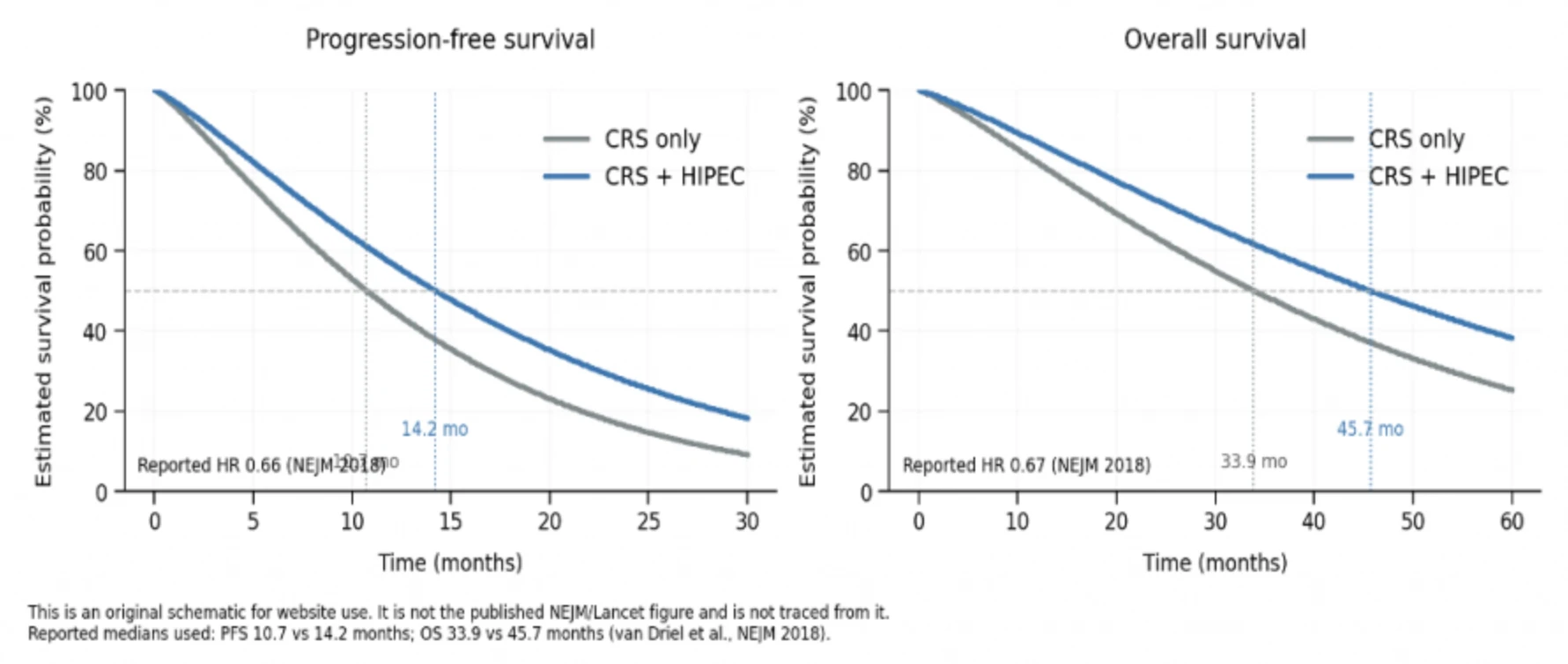
These results are important, but they should not be interpreted as meaning that HIPEC will provide the same benefit to every patient with ovarian cancer.
The trial involved a specific, carefully selected patient population, and treatment decisions need to be individualised.
What are the risks?
ICRS with HIPEC is major cancer surgery and carries significant risks.
Possible complications include:
- bleeding and the need for a blood transfusion
- infection
- blood clots
- chest or breathing complications
- bowel obstruction or prolonged recovery of bowel function
- bowel leakage following bowel surgery
- injury to the bowel, bladder, ureters or other abdominal organs
- urinary complications
- wound complications
- formation of a fistula
- pancreatic or upper abdominal complications
- kidney impairment
- effects on blood counts
- nausea and vomiting
- fatigue
- pain
- the need for intensive care
- the need for further surgery
- prolonged hospital admission
- complications related to anaesthesia.
Because this is extensive surgery, recovery can take considerably longer than after more straightforward gynaecological operations.
NICE highlights significant potential morbidity associated with cytoreductive surgery and HIPEC and recommends that the procedure is undertaken with appropriate specialist governance, consent, audit and monitoring arrangements.
HIPEC and kidney function
The chemotherapy used for HIPEC can affect the kidneys, which is why kidney function is carefully assessed before treatment and monitored during and after the operation.
Fluid balance and renal function are closely monitored around the time of HIPEC.
If your kidney function or overall health means that HIPEC would carry an unacceptable risk, the treatment may not be recommended.
Will I still need chemotherapy?
Usually, HIPEC forms part of a wider treatment programme rather than replacing systemic chemotherapy.
For patients receiving interval cytoreductive surgery, chemotherapy is generally given before surgery and further systemic treatment may be recommended afterwards depending on the individual treatment plan.
Your medical oncology and surgical teams will work together to determine the appropriate sequence and number of chemotherapy treatments.
How long does the operation take?
The duration varies considerably depending on how much cancer is present and which organs or structures need to be treated.
ICRS with HIPEC can involve several complex surgical procedures during the same operation and may take many hours.
Your surgeon will explain the anticipated procedure before surgery, including which operations may be required and the possibility that the final surgical plan may need to change according to what is found.
What can I expect after surgery?
Following major cytoreductive surgery and HIPEC, you will usually remain in hospital for a period of recovery.
You may initially require close monitoring, sometimes in a high-dependency or intensive care environment.
Your recovery will focus on:
- controlling pain
- monitoring kidney function and blood tests
- preventing blood clots
- managing nutrition and hydration
- encouraging safe mobilisation
- monitoring bowel function
- checking wounds and drains
- identifying and treating any complications promptly.
The length of your hospital stay depends on the extent of surgery and how your body recovers.
Once home, it can take several weeks or longer to regain your previous strength and stamina.
Nutrition and recovery
Nutrition is particularly important after major cancer surgery.
Your team may assess your nutritional status before surgery and provide advice about protein, calories and maintaining your weight.
After surgery, you may initially need dietary support while your bowel function recovers.
Your recovery will be gradual. Feeling tired for some time after such extensive surgery is common, and returning to normal activities should be guided by your surgical and oncology teams.
Will I have a stoma?
If part of the bowel needs to be removed, you may need a stoma.
A stoma creates an opening on the abdomen through which bowel contents leave the body into a specially designed bag.
Whether a stoma is required depends on where the cancer is located, how much bowel needs to be removed and whether the bowel can safely be reconnected.
If there is a possibility that you may need a stoma, this will be discussed with you before surgery and a specialist stoma nurse will usually be involved in your care.
What happens if the cancer cannot be completely removed?
The aim is to remove all visible disease where this can be achieved safely.
However, this is not always possible.
The extent and position of cancer may mean that complete removal would cause unacceptable harm. In this situation, your surgeon will make the safest decision based on what is found.
This is one reason why the treatment plan is individualised and why the final assessment of resectability during surgery is so important.
How is the treatment decided?
Your treatment should be discussed by a specialist multidisciplinary team (MDT).
This may include:
- gynaecological oncologists
- medical oncologists
- specialist radiologists
- pathologists
- specialist nurses
- anaesthetists
- dietitians
- physiotherapists
- other surgical specialists where required.
The MDT will consider your diagnosis, scans, response to chemotherapy, general health and wishes before recommending the most appropriate approach.
NICE's current ovarian cancer guidance specifically recognises the need for specialist assessment when considering cytoreductive surgery with HIPEC.
Is HIPEC a cure for ovarian cancer?
HIPEC should not be described as a cure.
Ovarian cancer can behave differently from one patient to another, and even after successful surgery and chemotherapy there remains a possibility that the cancer may return.
The aim of treatment is to achieve the best possible cancer control and, where possible, improve long-term outcomes.
Your individual prognosis depends on factors including the type and stage of your cancer, how well it responds to chemotherapy, how much cancer can be removed and your overall health.
At Gynae Solution, we will explain your individual situation in clear language and ensure that you understand the benefits, limitations and alternatives before making a treatment decision.
Why specialist experience matters
Cytoreductive surgery for advanced ovarian cancer can be highly complex.
It may involve surgery across several areas of the abdomen and pelvis and occasionally require collaboration with other surgical specialists.
HIPEC adds another technically demanding stage to the procedure and requires appropriate equipment, protocols, monitoring and specialist expertise.
For this reason, NICE recommends that cytoreductive surgery with HIPEC is undertaken with appropriate governance and monitoring arrangements.
Mr Jafaru Abu has a specialist interest in gynaecological oncology and complex cancer surgery, including advanced ovarian cancer surgery and cytoreductive procedures.
His approach is centred on careful patient selection, multidisciplinary decision-making and achieving the best possible cancer outcome while maintaining patient safety.
Making the right decision for you
There is no single treatment pathway that is right for every woman with advanced ovarian cancer.
For some patients, interval cytoreductive surgery may offer an important opportunity to remove extensive disease following chemotherapy.
For a carefully selected group, HIPEC may provide an additional treatment during that operation.
For others, the risks may outweigh the potential benefits and standard surgery and systemic treatment may be more appropriate.
The decision should always be based on your individual cancer, your response to treatment, your general health and your preferences.
At Gynae Solution, we will take the time to explain your options, answer your questions and ensure that you understand why a particular treatment is being recommended.
Arrange a specialist consultation
If you have been diagnosed with advanced ovarian, fallopian tube or primary peritoneal cancer and would like an expert opinion about cytoreductive surgery or whether HIPEC may be appropriate, a specialist consultation can provide an opportunity to review your diagnosis, scans and treatment plan.
We will explain the available options in clear, straightforward language and help you understand what each approach may mean for you.
Clinical detail and evidence
Written for referring clinicians and for patients who would like the detail behind the summary above.
What the procedure entails
The operation begins with interval cytoreductive surgery through a midline laparotomy, with the aim of removing all visible tumour or reducing residual disease to a minimum. The procedural scope may include hysterectomy, bilateral salpingo-oophorectomy where applicable, omentectomy, pelvic or abdominal peritonectomy, diaphragmatic stripping or resection, splenectomy, bowel resection or anastomosis, and other upper abdominal procedures where required. HIPEC is then delivered only if the patient has been optimally cytoreduced, in line with the conditional “go/no-go” approach described in the clinical pathway and consent documentation.
Your existing internal pathway documents also describe peri-operative preparation, including blood tests, renal assessment, bowel preparation, antibiotic prophylaxis, haemoglobin and nutrition optimisation, and peri-operative fluid and renal monitoring during HIPEC. The same materials list recognised risks of ultra-radical cytoreductive surgery and HIPEC, including bleeding, infection, injury to bowel or urinary tract, pleural complications, pancreatic leak, thromboembolism, ileus, fistulae, haematological toxicity and renal impairment.
Who may be considered for HIPEC?
The best-supported indication is advanced stage III epithelial ovarian, fallopian tube or primary peritoneal cancer treated with neoadjuvant chemotherapy and then interval cytoreductive surgery. In OVHIPEC-1, patients were eligible if they had at least stable disease after three cycles of carboplatin and paclitaxel, a WHO performance status of 0 to 2, normal blood counts and adequate renal function, and if complete or optimal cytoreduction was considered feasible at surgery.
The evidence base
The landmark OVHIPEC-1 phase III trial published in 2018 randomised 245 patients with stage III epithelial ovarian cancer to interval cytoreductive surgery with or without HIPEC using cisplatin 100 mg/m². The primary endpoint was recurrence-free survival and overall survival was a key secondary endpoint. The trial reported a median recurrence-free survival of 14.2 months in the surgery-plus-HIPEC group versus 10.7 months in the surgery-only group (hazard ratio 0.66, 95% confidence interval 0.50 to 0.87; P=0.003). Median overall survival was 45.7 months with HIPEC versus 33.9 months without HIPEC (hazard ratio 0.67, 95% confidence interval 0.48 to 0.94; P=0.02). Grade 3 to 4 adverse events were reported as similar between groups (27% versus 25%; P=0.76).
Benefits of HIPEC
The clearest potential benefit demonstrated in randomised evidence is improved progression-free and overall survival when HIPEC is added to interval cytoreductive surgery after neoadjuvant chemotherapy in carefully selected patients with stage III epithelial ovarian cancer. Contemporary reviews and meta-analyses continue to identify the interval setting after neoadjuvant chemotherapy as the most strongly supported clinical use-case.
Risks and limitations
HIPEC is not a minor adjunct; it is used in the context of major cytoreductive surgery and both surgery and HIPEC carry recognised risks. NICE states that evidence on safety shows frequent and serious but well-recognised complications, and that the evidence on efficacy is limited in quality; for that reason, NICE recommends that cytoreductive surgery with hyperthermic intra-operative peritoneal chemotherapy should be used only with special arrangements for clinical governance, consent, and audit or research.
The 2024 ESGO-ESMO-ESP consensus recommendations acknowledge OVHIPEC-1 and its findings, but they do not recommend HIPEC as routine standard of care for all newly diagnosed advanced epithelial ovarian cancers. Instead, the consensus emphasises that the results apply to a highly selected population and that delivery should be restricted to specialised centres with expert surgery, careful selection and structured data collection.
How I explain HIPEC to patients and readers
HIPEC can be described as a carefully selected enhancement to surgery rather than a stand-alone treatment. The aim is to remove all visible disease, then treat any microscopic residual cancer cells within the abdomen using heated chemotherapy before recovery and further systemic treatment. For the right patient in the right setting, the published evidence suggests a meaningful survival advantage. Equally, the procedure should not be portrayed as routine for every patient with ovarian cancer; its value depends on disease pattern, response to chemotherapy, surgical feasibility, physiological fitness and specialist MDT judgement.
Disclosure statement
Treatment decisions are individualized. HIPEC is considered only after specialist multidisciplinary review, and that not every patient with ovarian cancer will be suitable for this treatment. There is no evidence of benefit across all ovarian cancer settings. The strongest randomized evidence applies specifically to the interval debulking setting after neoadjuvant chemotherapy.
References
- van Driel WJ, Koole SN, Sikorska K, et al. Hyperthermic Intraperitoneal Chemotherapy in Ovarian Cancer. N Engl J Med. 2018;378:230 to 240. doi:10.1056/NEJMoa1708618.
- Aronson SL, Lopez-Yurda M, Koole SN, et al. Cytoreductive surgery with or without hyperthermic intraperitoneal chemotherapy in patients with advanced ovarian cancer (OVHIPEC-1): final survival analysis of a randomised, controlled, phase 3 trial. Lancet Oncol. 2023;24(10):1109 to 1118. doi:10.1016/S1470-2045(23)00396-0.
- 2025 exceptional surveillance of ovarian cancer: recognition and initial management, colorectal cancer, and oesophago-gastric cancer: assessment and management in adults (NICE guidelines CG122, NG151 and NG83).
- Ledermann J, Matias-Guiu X, Amant F, et al. ESGO-ESMO-ESP consensus conference recommendations on ovarian cancer: pathology and molecular biology and early, advanced and recurrent disease. Ann Oncol. 2024;35(3):248 to 266.
- Internal pathway materials prepared by Mr Jafaru Abu, including Introducing HIPEC, The Park Hospital; Guideline for CRS HIPEC copy; and Ultraradical surgery consenting process copy.
Patient leaflets
Written for patients, relatives and hospital personnel, to read before your operation and to keep afterwards.
De-bulking Surgery
Why surgeons aim to remove all visible disease, and how the extent of surgery affects survival.
Extensive Ovarian Cancer Surgery
For patients advised to have ultra-radical surgery for advanced ovarian cancer.
iCRS and HIPEC
Surgery after chemotherapy, sometimes combined with heated chemotherapy inside the abdomen.
Common questions
How soon can I be seen?
Daily appointments are available at The Park Hospital. Call the secretary on 0115 966 2049, or send an enquiry below and we will reply within 24 hours on business days.
Do I need a GP referral?
Referrals from GPs are welcome, and you can also enquire directly. If you are using private medical insurance, check with your insurer whether a referral is required for your policy. See GP referrals and fees and insurance.
What does a consultation cost?
A new consultation is £250 and a follow-up consultation is £150. The cost of any tests, procedures or surgery is quoted individually after your consultation. See fees and insurance.
Enquiries
Send us a message
Enquiries from patients and referring clinicians are both welcome. We endeavour to answer all enquiries within 24 hours on business days. If your case is urgent, please say so in your message or call the secretary directly.